Top Ten Individual Seasons in Pistons History
Mandatory Credit: Raj Mehta-USA TODAY Sports
We count down the top ten individual seasons in Detroit Pistons history and remember the contributions to the franchise by some of the team’s greatest.
Ranking individual accomplishments might seem counter-intuitive to a Detroit Pistons fan. Twice the Pistons have climbed to the NBA mountaintop, and neither time was on the back of a Kobe Bryant or a LeBron James.
More from PistonPowered
You will not find a league MVP on any Pistons roster in history, yet only five franchises have won more titles. Since 1981 only three teams have won a title without a current or former MVP on the roster. All three of those teams played in Detroit.
Not a single one of the following outstanding individual seasons occurred during one of the Pistons championship years. Somehow this organization finds success in a league by doing things a little differently. The Pistons are the zag to the NBA’s zig.
Poring through the data brought an interesting trend to light. Before each of the Detroit Pistons’ championship eras there were seasons on this list by extremely talented players, but never when the team reaches its greatest potential. As the team pushes to new heights, the best players’ statistics take a step back.
It is not easy to find a transcendent player in the NBA. In their entire history, maybe four of those players have put on a Pistons jersey. Two of them delivered championships. The other two fell short. The difference? The organization’s ability to surround them with the right pieces.
When that happens, the trophy case gets a little bigger. This list shows the different times where Detroit may have found a player to build around. The interesting part is seeing when they were able to capitalize on that and what went wrong when they could not. It provides insight on the past and maybe, just maybe, a little hope for the future.
Honorable Mention: George Yardley (1957-58)
George Yardley put up some numbers to give the new hometown fans something to cheer for in the Pistons first year in Detroit.
The seventh overall pick in the inaugural 1950 NBA draft, Yardley had his career year in 1957 while posting an impressive 27.8 points a game and pulling-down 10.7 rebounds. Using ahead-of-his-time jump shooting and athleticism, Yardley was able to win the league’s scoring title that season.
Per the LA Times,
“I don’t know if people today could truly understand how good he was,” former Laker coach Bill Sharman, who played against Yardley in college and in the NBA, told The Times some years ago. “He had probably the quickest release of anybody in the NBA. He was a deadly shooter and one of the only ones dunking the ball back then.”
Along with the scoring title, Yardley broke George Mikan‘s then NBA scoring record and surpassed 2,000 points in a season, the first to do so.
Yardley earned an all-star nod in every year he played in the league besides his rookie season. He retired early, keeping a promise to his wife, and was inducted into the basketball hall of fame in 1996.
#10: Jerry Stackhouse (2000-01)
By trading Grant Hill to Orlando prior to the 2000 season, the Pistons left Jerry Stackhouse as the only true scoring threat on the roster. He eagerly took full advantage.
Stackhouse scored 29.8 points a game to go along with 3.9 rebounds and 5.1 assists. Numbers like that should get him in the discussion for a better ranking, but unfortunately Stackhouse came by those points very inefficiently. In a Kobe Bryant fever-dream, Stackhouse took 24.1 shots a game to score those 29.8 points. Only once in his career did Kobe eclipse that many attempts.
On his way to setting the team record for points per game, he stumbled into the team records for field goal attempts, field goals missed, and usage rate.
However, blaming Stackhouse for taking so many shots may be unfair. Corliss Williamson, better suited for a bench role, served as Detroit’s next best scoring option. Calling the cupboard bare would be generous.
Stackhouse finished just a little over a point behind Allen Iverson for the league scoring title. He did, however, have the highest scoring game of the NBA season by dropping 57 points in a late season contest against the Chicago Bulls.
He even put an exclamation mark on the evening by scoring points 50 and 57 with reverse transition slams. Which apparently, he might still be capable of 15 years later.
Stackhouse was traded in a six player deal the next year that brought Richard Hamilton to the Detroit Pistons.
#9: Andre Drummond (2015-16)
Mandatory Credit: Tim Fuller-USA TODAY Sports
Andre Drummond put together a fourth year campaign that conjures up memories of the late Moses Malone and a younger Dwight Howard.
In three of the Pistons first six games Drummond put up dominating performances, posting 20 points and 20 rebounds. This rare feat helped establish Drummond as a top-flight NBA center and he translated the momentum into his first career all-star appearance.
He finished the season averaging 16.2 points and 14.8 rebounds. Numbers like that have not been seen in a Pistons uniform since Bob Lanier. The young center continues to find himself in elite company early in his career.
Not without his flaws, the much maligned free throw shooting remained an issue. Shooting a career and league worst 35.5 percent tends to get you some bad press, and it does not seem the league will be coming to his rescue any time soon with a rule change.
But the good outweighs the bad with Drummond, especially at just age 23. With improvement in key areas, he makes the Pistons hopeful for a return to the NBA’s elite.
By re-signing with the Pistons on a max five-year deal, Drummond has given the team time to build around him. It seems Detroit has found its next star, now it just needs to continue to surround him with the right pieces.
#8: Chauncey Billups (2005-06)
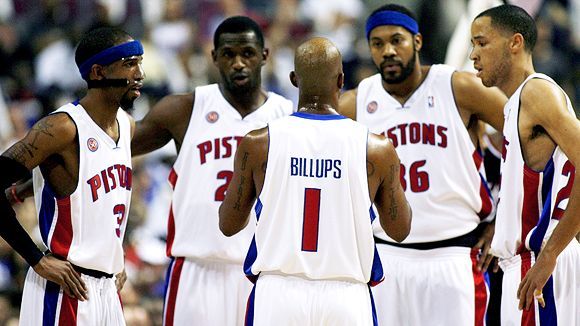
Chauncey Billups‘ best statistical season came during the Pistons best regular season in franchise history, amassing 64 wins. He put up a solid stat-line of 18.6 points, 3.1 rebounds, and 8.6 assists per game.
On his way to being named to the All-NBA second-team he earned a spot on the all-star team, along with Ben Wallace, Rasheed Wallace, and Richard Hamilton.
Four different players on this team averaged between 14 and 20 points, showing just how incredibly balanced they were as a unit. Billups, along with the rest of the team, seemingly sacrificed what could have been more impressive individual seasons for the team’s success. That sacrifice got them into every conference championship from 2002 through 2008, two finals appearances, and earned them one title.
In their championship year, 2004, no one player averaged more than 17.6 points a game. But when the Pistons needed points in the clutch, Billups was the man who often stepped up.
The Pistons seemed primed to compete at a high level for the rest of the decade, but Ben Wallace’s departure to Chicago in free agency at the end of this season marked the beginning of the end for this iteration of the Pistons. Billups would later be traded for Allen Iverson and the franchise trended down for several years.
#7: Dave Bing (1970-71)
After losing a coin flip in 1966, the Pistons were forced to “settle” for Dave Bing instead of Michigan Wolverine star Cazzie Russell. He went on to win rookie of the year, while Russell struggled during his first year in New York.
He won the NBA scoring title in 1968, but in 1970-71 delivers arguably his finest all around performance. Bing put up 27 points, 4.4 rebounds, and 5 assists a game en route to a first team all NBA selection. By shooting 46.7 percent from the field, the best mark of his career, he did so efficiently.
Dave Bing’s game was as smooth as the jazz in that highlight video. He excelled attacking the basket and finishing with either hand or dumping off to a teammate for a lay up. Bing never developed a great jump shot, but he could work the mid range game and featured some effective turn around moves.
Amid a tumultuous time for the franchise the Pistons could never build successfully around Bing and teammate Bob Lanier. After retirement Bing went on to become a successful businessman, served as mayor of Detroit, and joined the basketball hall of fame. His No. 21 jersey hangs in the rafters at the Palace of Auburn Hills.
#6: Dennis Rodman (1991-92)
Dennis Rodman famously won back to back titles with the Bad Boys in 1989 and 1990. Afterwards, the team began to age and players departed allowing Rodman a bigger role. This led to him posting his best stats in the 1991-92 season.
Rodman notched a team record 18.7 rebounds per game that year, along with 9.8 points on 53.9% shooting. By grabbing every board he could get his hands on, Rodman led the Pistons by doing all the dirty work. His impact went beyond the numbers as he constantly provided energy to the team.
Coming off of two consecutive defensive player of the year honors for play like the above, his efforts earned him a spot on the All-NBA third team.
He would soon depart the Pistons to play in San Antonio and later Chicago, where he would become easily the most interesting google search in NBA history. He has been inducted into the NBA hall of fame and the Pistons have retired his jersey.
#5: Isiah Thomas (1984-85)
Isiah Thomas, the true baby-faced assassin, had his best individual statistics in the 1984-85 season. By all accounts, he had the ability to be number one on this list and many others but the team’s success took precedent. You can look at his statistics year by year and see that as the team added more pieces Isiah’s production dropped.
Coming off a season where he won the all star game MVP and was named to the all NBA first team, Isiah took another step forward and put up historically great numbers. Thomas scored 21.2 points a game, dished out a then-league record 13.9 assists, pulled in 4.5 rebounds, and even added 2.3 steals a game for good measure.
With first team All-NBA honors in hand once again Thomas pushed the Pistons to the second round of the playoffs. Incremental improvements came each year, while suffering multiple heartbreaks, until they broke through and won back to back championships in 1989 and 1990.
He retired as the Pistons all-time leader in points, assists, and steals. His jersey is also in the rafters and he has been inducted into the NBA hall of fame.
#4: Ben Wallace (2002-03)
It is hard to name one early-2000’s Piston the “building block.” The team was well-balanced and incredibly interdependent, making it hard to imagine it succeeding without all the parts. But if forced to choose, Ben Wallace would be it.
Arriving in Detroit via the Grant Hill trade, not much was expected of Wallace. They were hoping to just get anything they could for a superstar they knew was leaving in free agency. Well to say the least, they got something.
While Grant Hill’s career was derailed by injury, Wallace’s took off. In the 2002-2003 he had one of his best seasons, all while cementing himself as one of the most dominant defenders of his era by earning his second straight defensive player of the year award. Often by doing something like this:
Wallace led the team in blocks with 3.2 per game while hauling in a Rodman-esque 15.4 rebounds. He was an efficient enough finisher on the offensive end, stuffing home 48 percent of his attempts, mostly dunks. Active hands in the passing lanes netted him 1.4 steals a game.
Like Rodman, numbers are insufficient to describe what Wallace provided the Pistons. He gave the franchise an identity, something it had lacked since the end of the Bad Boy era. Kids were wearing giant afros and screaming “defense!” until their lungs gave out. Their parents were liable to do the same.
The next year the Pistons would win the championship.
#3: Grant Hill (1996-97)
The second-biggest what-if in Pistons history, Grant Hill was as transcendent a talent the NBA has seen. He displayed the ability to embarrass some of the best defenders in NBA history on any given play.

Hill was the building block the Pistons had been looking for since the end of the Bad Boys. But unlike with Isiah Thomas before and Ben Wallace after, the team was not able to surround him with the right pieces.
In the 1996-1997 season Hill was a dominant force boasting a stat line of 21.4 points, 9 rebounds, and 7.3 assists a game. He shot 49.6 percent from the field and added 1.8 steals a game.
The advanced statistics shine a light on how historically great Hill was this year. He registered the highest player efficiency rating (PER) in team history at 25.5, and the second highest value over replacement player (VORP) of 7.9. For the uninitiated and curious, here is a guide to some advanced statistics.
After the 1999 season it was clear that Hill was going to leave for free agency, so the Pistons executed a sign and trade with the Orlando Magic. Just like that, perhaps the most talented Piston of all time had come and gone.
#2: Bob Lanier (1973-74)
Bob Lanier might be the least appreciated superstar in franchise history. You see his jersey at the Palace, and you might hear his name thrown around by George Blaha now and then. But not many people say his name like they say Isiah, Bing, Ben, or Chauncey.
Lanier was every bit as talented as those players. From 1971 to 1978 he enjoyed the longest and most consistent period of excellence in Pistons history. Lanier perennially put up numbers approaching 25 points and 12 rebounds.
Defensive statistics only started being kept track of in the middle of this stretch, so picking his best season is not an exact science. But it is hard to imagine him having a better year than the one he had in 1973-74.
Lanier scored 22.5 points a game, grabbed 13.3 rebounds, handed out 4.2 assists, and swatted 3 shots a game. He shot over 50% from the field and posted the franchise’s best ever VORP of 8.1.
Lanier and Dave Bing led the team to a 52-30 record and fell in game 7 of the western semifinals on a Pistons specialty, a heartbreaking inbound pass gone wrong. This was the closest Lanier would get to a title with the Pistons. With new GM Jack McCloskey taking over, the Pistons decided to start fresh and trade Lanier.
He later ended up joining the not so-exclusive-club of players to punch Bill Laimbeer. Regardless, the Pistons still hung up his No. 16 jersey and Lanier is in the Pro Basketball Hall of Fame.
#1: Ben Wallace (2001-02)
Mandatory Credit: Mark J. Rebilas-US PRESSWIRE
Ben Wallace lays claim to the best season in Detroit Pistons history. He put up 7.6 points, 13 rebounds, and an astounding 3.5 blocks a game. That was enough to get him the team record for blocks in a season with 278, and that mark also led the NBA that year.
He hit 53.1 percent of his field goals and stole the ball 1.7 times a game. Exploding onto the scene as he did culminated with him winning his first of four Defensive Player of the Year awards, and marked the beginning of a new era for Detroit basketball.
With another chance at a core player, the Pistons made sure they would surround him with the perfect pieces.